Cluster headaches are among the most severe pain conditions known. Although many indications suggest that an undetected Binocular Vision Dysfunction (BVD) could be a key trigger for cluster headache attacks, no scientific study has yet investigated this connection. This is precisely why a double-blind study is urgently needed: to determine whether reducing the strain on the oculomotor system – for example by using prism glasses – can actually decrease the frequency and intensity of cluster headache attacks.
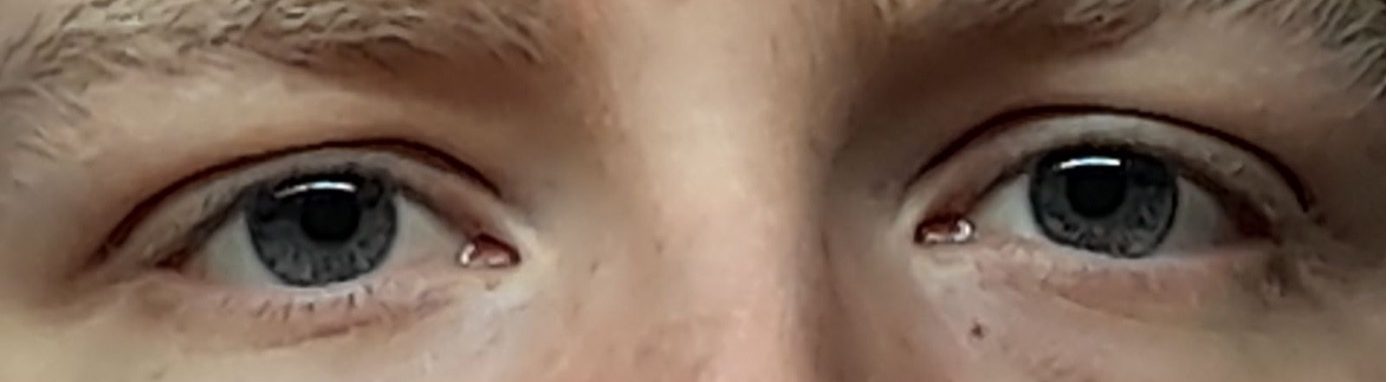
This page summarizes existing observations, anatomical relationships, and the experiences of many affected individuals that suggest an inflammation of the trochlea (superior oblique tendon pulley), located directly above the painful eye, may play an important role in the development of cluster headaches. It also explains why simple tests, such as covering one eye, often lead to significant improvement – and why prism glasses provide lasting relief for many patients.
Since these indications have not yet been scientifically examined, I am pursuing a clear goal: to draw the attention of physicians and researchers to a potential, previously overlooked mechanism and to call for the implementation of a double-blind study, so that affected individuals can finally receive the clarity and support they need.
A Previously Overlooked Trigger of Cluster Headaches
Many of the estimated 150,000 people affected in Germany have been suffering from severe attacks for years or even decades—often accompanied by suicidal thoughts, inability to work, and significant impairment in daily life. Despite modern diagnostic methods, the true cause of the pain remains unclear, and treatment focuses primarily on managing attacks with medication.
In recent years, however, a previously overlooked potential trigger has emerged: in a large proportion of patients, an undetected heterophoria (latent strabismus) appears to play a central role. Latent strabismus is not a disease and is estimated to affect around 70% of the population. Most people can compensate for this minimal misalignment without any issues, but in individuals with cluster headaches, this compensatory ability seems to be overwhelmed.
The painful eye often shows a slight outward deviation and must constantly “work” during binocular vision to keep both images aligned. This leads to continuous strain on the eye muscles and on the superior oblique tendon and its trochlea (the cartilaginous pulley) located above the affected eye.
This trochlea lies at the nasal bridge directly above the painful eye and is connected to the brain through short neural pathways. When irritation or inflammation occurs in this region, it can generate extremely intense pain signals that the brain perceives as cluster headache attacks. Additional factors such as histamines or alcohol consumption may further intensify this inflammation.
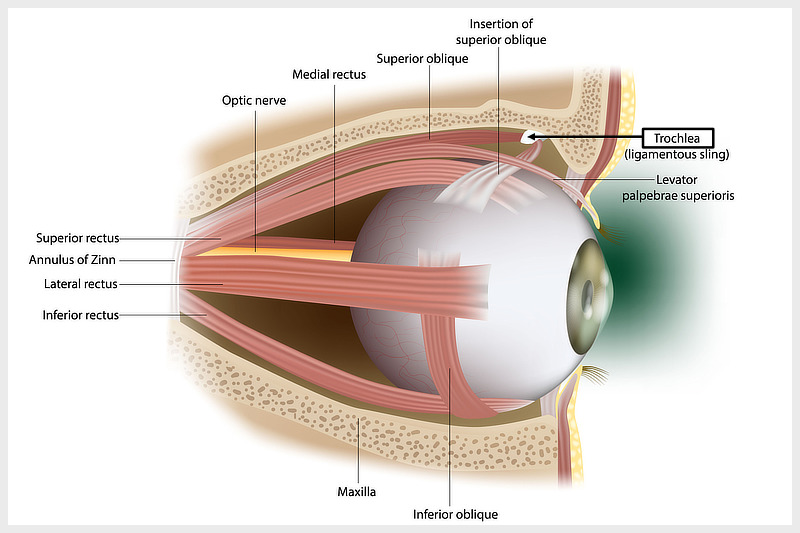
Notably, many attacks occur primarily during REM sleep.In this sleep phase, rapid, jerky eye movements take place, which can further strain an already irritated trochlear tendon sheath. This connection is also supported neurologically: Prof. Dr. Stefan Evers and Prof. Dr. Svenja Happe consistently report that cluster attacks arise predominantly during REM sleep.
The Eye Patch Test: A Recurrent Pattern
Over the past years, more than 100 people with cluster headaches have followed my recommendation to cover their painful eye with an eye patch for one to two days. The result was clear in the vast majority of cases: the number and intensity of attacks decreased significantly, and in several chronic patients they disappeared entirely. Once the eye patch was removed, the attacks returned in full strength shortly afterward—a clear indication that binocular vision and muscular overload play a central role.
Many patients also reported that typical triggers such as alcohol, flickering light, air travel, or strong solvents no longer provoked attacks while using the eye patch. Without the patch, however, the same triggers reliably led to new episodes. Two professors / statisticians in the medical field described this observation as an objective indicator of the underlying pain mechanism: if attacks are markedly reduced under an eye patch, this serves as strong functional evidence for a binocular trigger.
The characteristic ptosis observed during a cluster headache attack can also be interpreted in this context: it functions like a “natural eye patch,” temporarily interrupting binocular vision and allowing short-term relief of the extraocular muscles.
Neurologists can easily test this mechanism by advising their patients to cover the painful eye for two days. Many affected individuals report that doing so allowed them to prevent a significant number of attacks.
Patient reports can be found here:
- Cluster Headache & Prism Glasses – Patient Experiences
- YouTube Channel of the Praxis für Winkelfehlsichtigkeit
Prism Glasses as Long-Term Relief for Cluster Headaches
A prism glasses prescription ensures that the retinal images of both eyes align without effort. The eye muscles no longer need to compensate for the misalignment, the trochlear tendon sheath is relieved, and inflammation can subside—similar to the healing process of other tendon sheath inflammations. For many people with cluster headaches, this leads within days to weeks to:
- a significant reduction in attacks,
- in some cases complete freedom from pain,
- less background pain behind the eye,
- reduced sensitivity to typical triggers,
- and a noticeably lower need for medication.
Many sufferers have been able to significantly reduce or even discontinue their medication thanks to prism glasses. Importantly, patients remain pain-free or largely symptom-free only as long as they continue wearing the prism glasses. When they stop wearing them, attacks often return within a short time—exactly as they do after removing an eye patch. This provides further strong evidence that strain on the oculomotor system is the driving factor behind the pain.
In people with cluster headaches, the required prism values are typically very low, often below 2.00 prism diopters. Such minimal deviations are often not detected by ophthalmologists or opticians using standard measurement techniques. I do not assess heterophoria using the MKH method; instead, I employ my own measurement approach aimed at correcting only the portion of the misalignment that the eye muscles cannot compensate for on their own. This keeps prism values low and stable—and ensures that there is no risk of “pushing the values up” to a level that might later require surgical correction. Surgery for strabismus is not considered until total prism values reach approximately 50–60 prism diopters; values between 0.25 and 2.00 prism diopters are far below that threshold.
Another important benefit: unlike many medications, prism glasses have no systemic side effects. If they help, patients are happy to wear them; if they do not, they can simply stop using them—with no negative consequences and everything returning to the previous state.
Why This Connection Has Been Overlooked Until Now
Neurologists understandably look for neurological disorders when diagnosing cluster headaches. Ophthalmologists, on the other hand, search for pathological changes in the eye itself. However, heterophoria is neither of these—it is a functional misalignment. For this reason, it is generally not considered as a potential cause.
The Professional Association of German Ophthalmologists (BVA) has pointed out in a press release that headaches often originate in the eyes and can be triggered by an imbalance of the extraocular muscles (heterophoria). Nevertheless, this perspective has so far been largely neglected in the context of cluster headaches. Many patients who experienced significant improvement for the first time with prism glasses report that their experiences were ignored or dismissed as „unproven“ by neurologists and support groups. In online forums, numerous patient reports were even deleted—not because they were disproven, but simply because no study exists yet to validate them.
This gap between experience and evidence is precisely what makes scientific investigation so important. In conversations with patients I have been able to help, I frequently hear the phrase: “Whoever helps is right.” But my goal is not to be “right.” My aim is for physicians to listen to what patients describe—and to follow up on these indications with a rigorous, well-designed study.
Why a Double-Blind Study Is Necessary
The observations made so far—the effect of the eye patch, the improvement seen with prism glasses, the anatomical correlations, the role of REM sleep and histamines, and more—form a consistent overall picture. Yet without a double-blind study, this potential mechanism will not gain scientific recognition. I estimate that approximately 75% of people with cluster headaches could achieve a significant reduction in attacks or even complete remission.
A double-blind study on the effectiveness of prism glasses in cluster headaches could:
- objectively demonstrate the binocular trigger mechanism of the pain,
- scientifically validate the efficacy of prism glasses,
- reduce unnecessary medication therapies and diagnostic procedures,
- and offer new hope to many individuals who are currently considered “untreatable.”
The estimated cost of such a hospital-based study is around €500,000. I am unable to finance this sum on my own. However, I am prepared to provide all study participants with prism glasses free of charge. To make this possible, I need collaboration with neurologists, headache centers, clinics, and research teams who are willing to investigate this approach together.
Cluster Headache Study: Invitation to Collaborate
Since 2018, I have been correcting heterophoria in people with cluster headaches, and during this time I have encountered many profound personal stories: individuals who suffered unbearable pain for years, became unable to work, or lost all hope. Some were suicidal due to the severity of their pain. For many of them, prism glasses were the first approach that went beyond mere symptom management and brought real, lasting improvement.
Would it not be reasonable to examine these observations in a rigorous scientific study? If it can be confirmed that heterophoria can trigger cluster headaches—and that prism glasses can significantly reduce or even eliminate these symptoms—it would be a milestone for everyone affected.
I am therefore seeking collaboration with all interested physicians and researchers, especially with chronic cluster headache patients as study participants, as the benefits can be demonstrated particularly clearly in this group.
I would be delighted to hear from you.
Jürgen Peschlow
State-certified Optician / Optometrist