Do you suffer from episodic or chronic cluster headaches?
Have doctors been unable to identify a clear cause despite numerous examinations — and the usual therapies simply do not bring lasting relief?
Are you looking for an effective, medication-free solution that addresses the root of your symptoms?
Then you are in the right place. For many patients, a key trigger for their cluster headaches lies where almost no one thinks to look: in binocular vision.
For a significant number of people, cluster headaches are triggered by a binocular vision dysfunction (BVD) — also known as binocular vision misalignment or heterophoria. This misalignment causes symptoms only during two-eyed (binocular) vision and can trigger cluster headache attacks. It is not a disease, but a muscular imbalance in the eye movement system.
Many affected individuals notice that their cluster attacks decrease significantly when one eye is covered with a soft, completely light-blocking eye patch for several days.
The reason: covering one eye temporarily eliminates the need to compensate for the binocular misalignment — and thus removes the pain-triggering stimulus. As a result, cluster headaches typically diminish after a few days.
This clear and reproducible effect has convinced even strong skeptics that, in many people, cluster headaches are triggered by an undetected binocular vision dysfunction.
For this reason, patients with cluster headaches from many countries have come to me to have their binocular misalignment corrected. After being fitted with individually adjusted prism glasses, more than 80 patients have recorded personal videos to share their experiences and help inform others suffering from cluster headaches.
You can find these testimonials here:
- Cluster Headache & Prism Glasses – Patient Experiences
- YouTube Channel of the Praxis für Winkelfehlsichtigkeit
The First Step Toward Pain Relief for Many Patients: The Eye Patch Test
You may still be skeptical at this point — and that is completely understandable.
You do not need to book an appointment with me right away or take on a long journey.
You can first test for yourself whether your cluster headaches are actually triggered by binocular vision or a binocular vision misalignment (heterophoria).
The simplest way to do this is with a medical eye patch test. Detailed instructions can be found here: Eye Patch Test for Cluster Headaches.
Important: Please make sure to use a soft, fully light-blocking medical eye patch that does not press on or touch the painful eye.
Many people with cluster headaches report that wearing the eye patch continuously for several hours or days leads to typical changes:
- The pressure sensation around the painful eye decreases after a few hours. Many patients had not noticed this pressure anymore because it was constantly present. After removing the patch, the uncomfortable pressure often returns immediately.
- Pain at the temple on the cluster headache side often improves, as do neck tensions and light sensitivity.
- As time goes on, the stabbing or pulling pain around the eye subsides — the cluster headache attacks become weaker and less frequent.
If you notice these changes, it is a strong indication that:
Your cluster headaches are very likely triggered by a binocular vision dysfunction (heterophoria).
This also applies to nighttime attacks, which are then triggered during REM sleep. More on this later.
Important to know: The test does not work for everyone, nor does it work at the same speed for all patients. Around 70% notice improvement within a few hours up to three days. For others, it takes longer — sometimes up to two weeks. If you do not feel significant improvement after several days, this does not mean that no binocular misalignment is present. There are many cases in which cluster headaches were completely resolved with prism glasses even when the eye patch test did not show an obvious effect. In such situations, the visible misalignment of the painful eye can be an important clue.
The Visible Misalignment of the Painful Eye
Another clear and meaningful way to identify a connection between binocular vision dysfunction (heterophoria) and cluster headaches is a visible misalignment of the affected eye.
Many people suffering from cluster headaches show a visible vertical deviation of the painful “cluster eye.” This means the affected eye sits slightly higher or lower compared to the other eye. In everyday language, this is sometimes referred to as a “strabismus” or “wandering eye.”
This visible deviation is a strong indicator of a vertical binocular vision misalignment — and therefore of a functional imbalance in the eye movement muscles.
If you are unsure, you can:
- ask someone to take a close look at your eye alignment, or
- send me a photo of your eye area at info@richtig-sehen.de.
In most cases, I can already see from a photo whether a vertical heterophoria (vertical misalignment) is present.
All people who came to me with cluster headaches after a positive eye patch test had one thing in common:
The painful eye deviated slightly upward or downward compared to the other eye.

For example: You may notice in the photo that the left eye (from the perspective of the person shown) deviates slightly upward compared to the other eye.
This is the binocular misalignment / binocular vision dysfunction (heterophoria) that the painful eye must constantly compensate for with its eye muscles. When this misalignment is precisely corrected with prism glasses, the continuous muscular strain is removed — and this is exactly why so many people with cluster headaches experience a significant reduction in their symptoms, in most cases even complete freedom from pain.
Why a Binocular Vision Misalignment Can Trigger Cluster Headaches
Above the eye lies the trochlea, a small tendon sheath through which one of the eye movement muscles passes and functions like a pulley. In ophthalmology, this structure is also referred to as the superior oblique pulley or cartilage ring. It is highly sensitive to continuous mechanical strain.
Exactly this type of strain occurs when a vertical binocular vision misalignment (vertical heterophoria) is present: the painful eye sits slightly higher or lower than the other. This minimal difference is enough for both eyes to “look” at slightly different points. To still produce a single, unified image, the eye movement muscle of the affected eye must constantly compensate and pull the eye into the correct position.
You can imagine it like a rubber band kept under tension all day long: the eye wants to remain in its slightly offset resting position, but the muscle must continuously correct it upward or downward so that binocular vision can function.
This permanent muscular effort can lead to an inflammation of the trochlea — similar to a tendon sheath inflammation in the hand or arm. This, in turn, produces stabbing, pulling, or drilling pain — exactly the type of pain that people with cluster headaches typically describe.
There are also indications from pain medicine suggesting that the trigger for cluster headaches does not originate in the brain but directly in the area of the eye. Prof. Dr. Hartmut Göbel from the Pain Clinic in Kiel writes: “…it is likely that cluster headache arises in structures around or behind the eye.”
Nevertheless, in neurology the cause of cluster headaches is traditionally sought primarily in the brain. This contradicts both what Prof. Göbel describes and what many patients consistently report: cluster headache feels as if it originates directly in the eye.
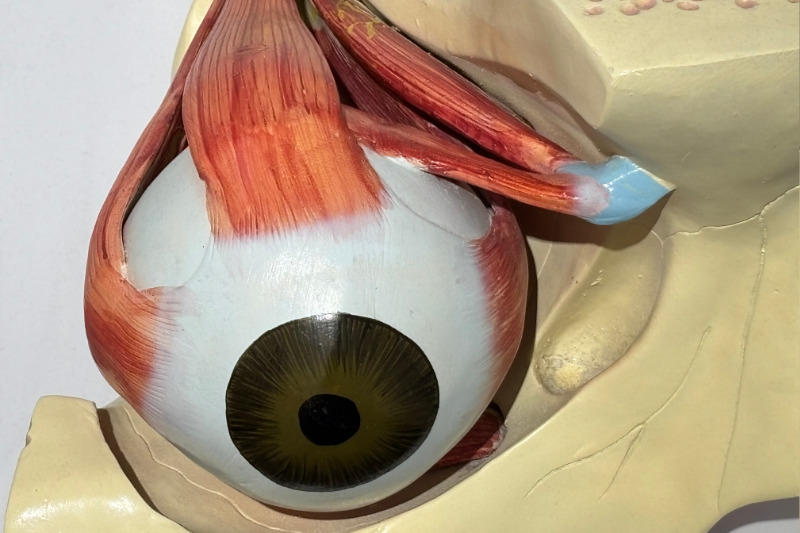
Indications That an Inflamed Trochlea May Be the Trigger for Cluster Headaches
Several striking parallels suggest that a tendon sheath inflammation in the region of the eye — specifically in the trochlea — may indeed be the underlying trigger for cluster headaches:
- Identical pain patterns: Both cluster headaches and tendon sheath inflammations can occur episodically (in phases) or chronically (persistently), depending on whether the mechanical strain continues.
- Same pain characteristics: The pain during a cluster headache attack is stabbing and pulling — exactly the same characteristics seen in classic tendon sheath inflammation.
- Cortisone is effective in both conditions: Cortisone is known to be an effective treatment for tendon sheath inflammations — and for the same reason, it also helps relieve cluster headache symptoms.
- Pain point directly at the trochlea: Many patients report that the most intense pain is located directly above the eye — the exact location of the trochlea.
- Tenderness and restricted eye movement: The upper inner corner of the eye is often pressure-sensitive, and the painful eye frequently shows reduced mobility, especially when looking up or down. These are also typical signs of tendon sheath inflammation.
- Visible signs of inflammation: The painful area is often red, swollen, and warm to the touch — cooling provides relief in both conditions.
- Strictly one-sided pain: Cluster headaches are always unilateral — just like a vertical binocular misalignment only strains one eye. Only that eye develops the characteristic pain.
- The eye patch confirms the mechanism: When the eye patch eliminates the misalignment-related strain, cluster headaches improve within a few days; when the patch is removed, the pain returns immediately. In each individual case, this provides additional evidence for a binocular pain trigger (vertical heterophoria). The drooping eyelid frequently observed in people with cluster headache can be interpreted as a kind of “body’s own eye patch” — an evolutionary protective mechanism that prevents binocular vision and thereby reduces ocular pain.
- Hormonal influences: During pregnancy, many women report fewer attacks — likely due to increased progesterone levels, which have anti-inflammatory effects and may also reduce inflammation in the trochlea.
Additionally: The trochlea is located outside the brain, yet very close to it. The nerve connections in this area are extremely short — which explains why the pain is perceived so intensely and often “radiates across the entire face.”

The Healing Process: What Happens When the Strain Is Removed with Prism Glasses
When the strain on the trochlea is relieved by correctly fitted prism glasses, the inflamed tendon sheath can begin to heal. Many patients therefore report improvements in a typical sequence:
- first, a reduction in pressure around the affected eye
- then, a decrease in temple and neck pain
- followed by increasingly fewer attacks
- and finally — with continuous relief — complete freedom from pain
This healing process is exactly the same as with any other tendon sheath inflammation:
as long as the mechanical strain persists, the pain persists as well.
Once the strain is removed, the inflammation can heal.
This also applies to the trochlea — regardless of whether you experience episodic or chronic cluster headaches.
Additionally, REM sleep plays an important role: rapid eye movements during REM sleep place particularly high stress on the trochlea and can trigger nighttime attacks. Once the strain is eliminated during the day through prism glasses and the trochlea begins to heal, daytime attacks usually disappear first — followed by nighttime attacks.
Prism Glasses for Cluster Headaches: Specialized Measurement & Guarantee
If the eye patch test — and possibly a visible vertical misalignment — indicate a binocular vision dysfunction in your case, the next step is a precise measurement in my practice.
A written registration is required for this. You can find all information here: Contact & Appointment.
I have been working for many years with my own measurement and correction methodology, which is fundamentally different from the controversial MKH/Haase-method.This approach is the result of decades of specialization exclusively in binocular vision dysfunctions — including those that trigger cluster headaches.
Because this methodology allows me to eliminate all known risks associated with MKH prism corrections, I offer every cluster headache patient a guarantee of correction success: You only pay once the prism glasses are effective. I also guarantee that the prism values will not increase, but remain permanently low.
I am able to provide this guarantee because hundreds of patients have already come to me. The large number of cases has given me extremely precise practical knowledge of how a binocular misalignment must be corrected in order to reliably eliminate cluster headaches.
Misdiagnoses Due to Insufficient Measurement Methods
Many people who want to determine whether a binocular vision dysfunction is contributing to their cluster headaches first turn to an ophthalmology practice. There, the suspicion is almost always dismissed immediately — often with statements such as “binocular vision dysfunction doesn’t exist” or “that’s nonsense.”
Yet I have now worked with well over 200 individuals whose binocular vision dysfunction had previously been ruled out by an ophthalmologist, even though it was clearly present. The reason: the types of binocular misalignments commonly associated with cluster headaches and migraine are often so subtle that they cannot be reliably detected with standard measurement methods used by most ophthalmologists and many opticians.
The result is a frequent misdiagnosis of “no binocular vision dysfunction (BVD)”, with the unfortunate consequence that the actual cause of the symptoms remains undiscovered.
Because the experiences of so many patients are so consistent, I have been trying for years to initiate a scientific study examining the connection between binocular vision dysfunction and cluster headaches. I would be willing to provide care for all participants free of charge within such a study. So far, however, there has been no interest from the neurological field — even though many patients no longer require medication after a precise prism correction.
Experiences from Other Patients: Why Many Were Skeptical at First
It is entirely understandable if you still have doubts at this point. Most people who now live normal, pain-free lives initially could not imagine that their extreme, stabbing pain could have anything to do with binocular vision — or that prism glasses could have any effect on cluster headaches.
But the experiences of other patients paint a very clear picture. More than 80 individuals with diagnosed episodic or chronic cluster headaches — all with confirmed neurological diagnoses, many after stays in pain clinics such as Kiel or Königstein — have documented their experiences in videos.
Many were unable to work, retired due to their condition, and under enormous emotional and physical strain. These people are not trying to sell you anything. They want others to know that there is a way out — and that a correctly fitted prism correction has helped many of them far more than all previous treatments and medications combined.
Here, four patients share their stories — each of whom became pain-free with my prism glasses (videos in German):
You can find more testimonials here:
- Cluster Headache & Prism Glasses – Patient Experiences
- YouTube Channel of the Praxis für Winkelfehlsichtigkeit
Selbsthilfegruppe Clusterkopfschmerz und Winkelfehlsichtigkeit
Support Group: Cluster Headaches and Binocular Vision Dysfunction
If you have questions or would like to connect with others affected by cluster headaches, you are warmly invited to join the German support groups “Clusterkopfschmerz und Winkelfehlsichtigkeit” (Cluster Headaches and Binocular Vision Dysfunction) on Facebook:
- Private Facebook Group „Clusterkopfschmerz und Winkelfehlsichtigkeit“
- Public Facebook Group „Clusterkopfschmerz und Winkelfehlsichtigkeit“
These groups were founded several years ago by people with cluster headaches who were not allowed to share their experiences with prism glasses in general cluster headache forums — where discussions are often limited exclusively to medication-based treatments.
In these groups, things are different: here, people can openly discuss what has truly helped them with their cluster headaches. Together, the two groups now have more than 850 members. You will find many individuals there who have become permanently pain-free with my prism glasses, who have been able to return to work, and who are once again able to live completely normal lives. These members are happy to answer your questions — and I am also part of the group.


Important Notes on Misinformation and Prism Glasses Measured Using the MKH Method
In several large cluster headache forums, you may come across critical statements about prism glasses. However, these statements apply exclusively to prism glasses measured using the MKH / Haase method — the standard procedure used by almost all ophthalmologists and opticians in Germany, Austria, and Switzerland. This is not the procedure I use.
I work with my own measurement methodology, which eliminates all known risks and disadvantages associated with MKH/Haase prisms. Many patients who come to me have previously had negative experiences with “incorrect” or unsuitable MKH prism glasses — in some cases, they experienced no improvement, and in others, there was even concern about increasing prism values or fears of eventually needing eye muscle surgery. This risk is one of the main criticisms of the MKH method and is regularly discussed by many ophthalmologists. However, it is important to understand:
These criticisms cannot be applied to all prism glasses — because not all prism glasses are the same.
With my own measurement approach, I can ensure that the known risks associated with MKH/Haase prisms do not occur. In all these years, I have never had a single case in which the prism values increased after my correction. For almost all patients with cluster headaches, the total prism values remain below 2.00 prism diopters — a range in which there is absolutely no surgical risk. Surgery for binocular misalignments is only considered starting at around 30.00 prism diopters per eye.
Therefore, I encourage all patients not to be unsettled by general warnings or discussions in online forums. Ultimately, what matters is what works for you in everyday life. This is exactly what I hear again and again from patients who have experienced the effect themselves: “Whoever helps is right.”
Form your own opinion and make your decision based on your personal experience, not on general statements that do not apply to the prism glasses I prescribe.
FAQ: Cluster Headaches, Binocular Vision Dysfunction (BVD), and Prism Glasses
Here you will find answers to frequently asked questions about cluster headaches, binocular vision dysfunction, and prism glasses:
Why Do Many Nighttime Attacks Occur During REM Sleep?
Renowned neurologists such as Prof. Dr. Stefan Evers and Prof. Dr. Svenja Happe report that cluster headache attacks occur particularly frequently during REM sleep. In this sleep phase, the eyes move extremely quickly and abruptly. These rapid movements place significant strain on the trochlear tendon sheath — the very structure that is already overstrained in individuals with a binocular vision misalignment. As the night progresses, REM phases become more intense. It is precisely during these periods that many patients experience their most severe attacks. To me, this is a strong indication that the movement of the tendon within the trochlea may play a central role in triggering nighttime cluster headache attacks.
Why Do Cluster Episodes Often Begin in Autumn or Spring?
Many people with episodic cluster headaches report that their episodes typically start in autumn or spring. There are several reasons for this:
- Flickering light through bare trees: When the sun is low, driving produces intense flickering light — a strong trigger.
- Increased need for visual compensation: To reduce glare, the “cluster eye” must compensate for the binocular misalignment extremely well — significantly increasing the strain on the tendon sheath.
- Sinus inflammations: In autumn due to colds, in spring due to pollen. Both increase the risk of inflammation in the trochlea.
For this reason, many of my episodic patients wear their prism glasses consistently even during pain-free periods — because they know they would otherwise very likely slip into the next episode.
Which Triggers Can Reduce the Eye Muscles’ Ability to Compensate — and Thus Promote Cluster Headache Attacks?
Many typical cluster headache triggers become easier to understand when you recognize how intensely the eye movement muscles must work to compensate for a binocular vision misalignment. Whenever these muscles are weakened or must work exceptionally hard, the strain on the trochlea increases — and with it, the risk of an attack.
- Alcohol, for example, relaxes all muscles, which makes it harder for the eyes to compensate for the binocular misalignment. In extreme cases, this can even lead to double vision — a common immediate trigger for an attack.
- Weather changes can negatively affect circulation, overall physical well-being, and muscle tone — many patients report an increase in attacks during such periods.
- Heat, hot baths, and saunas relax the eye muscles, reducing their ability to compensate for the misalignment — attacks may be triggered.
- Oxygen deficiency at higher altitudes reduces the performance of all muscles, including the eye movement muscles — often resulting in more cluster headache attacks.
- Oxygen therapy: Inhaling pure oxygen increases muscle performance, allowing the binocular misalignment to be compensated more effectively. Many patients are able to shorten or even stop attacks using this method.
- Physical restlessness and activity: Increased breathing during movement improves oxygen supply to the muscles. This also enhances the performance of the eye movement muscles — many patients report that they can overcome attacks more quickly, for example by doing intense push-ups.
- Cooling the eye area can positively influence the muscles’ ability to compensate and may help an attack subside more quickly.
- Hunger or dehydration weaken overall muscle performance — including the ability to compensate for the binocular misalignment.
- Energy drinks, glucose, or magnesium can increase muscle performance and may help prevent or reduce the severity of attacks.
- Colds and other illnesses weaken the musculature and thus reduce compensation ability — cluster headaches often increase during such phases.
- Napping: During sleep, all muscles relax, including the eye movement muscles. When the eyes are opened suddenly, the muscles must contract abruptly to compensate for the misalignment — this can trigger attacks right after falling asleep or upon waking.
- Flickering light, bright light, TV, screen work, cinema: Intense light stimuli and visually demanding tasks force the eye muscles to compensate as completely as possible in order to improve visual clarity and reduce light sensitivity. This increases the strain on the trochlea — and may trigger attacks.
- Stress negatively affects the muscles’ ability to compensate and is therefore a common trigger for cluster headache attacks.
The constant tension in the eye muscles also affects anatomically connected muscle groups — such as the temples, forehead, jaw, and neck. Many patients notice that these areas become significantly more relaxed once the binocular misalignment is corrected with prism glasses.
Is Cluster Headache a Disease?
Many people with cluster headaches experience pain of almost unimaginable intensity. Numerous patients — including women who have experienced both childbirth and cluster headaches — report that cluster headache pain is even stronger than labor pain.
Despite this extreme level of pain, cluster headache is, in my view, not an independent disease. Rather, it behaves like a warning signal from the body — similar to how labor pain is not a disease, but a reaction to a physiological process.
Every pain has a cause. When that cause is removed, cluster headaches usually disappear as well.
Based on my experience, each attack points to a specific mechanical source of pain: a tendon sheath inflammation in the eye movement system above the affected eye.
This inflammation results from continuous strain — caused by a binocular vision misalignment (heterophoria) that must be compensated during binocular vision.
Several indicators support this connection:
- Improvement with an eye patch: Many patients report that their pain decreases or even disappears within one to three days when one eye is completely covered with a soft, light-blocking eye patch (see above). This is objective evidence that the pain trigger lies in binocular vision — and therefore in a misalignment that causes symptoms only when both eyes are open.
- Visible misalignment of the affected eye: In most people with cluster headaches, this misalignment is externally visible. The affected eye sits slightly higher or lower than the other (see above). This visible deviation is a clear sign of a vertical muscular imbalance.
- Immediate reaction when prism glasses are removed: People with chronic cluster headaches report that pain often returns within a short time after removing effective prism glasses. In episodic patients, removing the glasses can trigger individual attacks — or even initiate a new episode. In both cases, the direct link between binocular misalignment and cluster headache becomes unmistakably clear.
- The striking “alcohol test”: Many patients experience severe attacks after drinking alcohol — as long as both eyes are open. However, when the affected eye is covered with an eye patch, alcohol can often be tolerated without triggering an attack. Numerous patient reports confirm this connection. It is important, however, that the patch is worn for as long as the alcohol remains active in the body.
- No known disease behaves this way: There is no known medical condition that disappears solely by covering one eye or wearing prism glasses — and immediately returns when they are removed. Such a pattern clearly contradicts the idea of an independent disease and strongly supports a mechanical cause of pain.
Therefore, cluster headache — especially after a positive eye patch test or when a visible misalignment is present — should be understood as a clear signal from the body. With every attack, it indicates that a strain-causing binocular vision misalignment is present and needs to be corrected. A lasting and effective relief is only possible with a precisely fitted pair of prism glasses, as they reliably eliminate the strain in binocular vision that triggers the pain.