For many people with episodic or chronic cluster headaches, the cover test using a light-blocking eye patch is the first step in determining whether their pain is triggered by a binocular vision misalignment. The test is easy to perform, completely safe — and often provides a surprisingly clear answer after only a short period of time.
How to Perform the Eye Patch Test
If you are currently experiencing an episode or suffer from chronic cluster headaches, cover the painful eye continuously for two to three days with a soft, fully light-blocking eye patch. The best time to do this is on a weekend or during a period with fewer obligations. Because you will be seeing with only one eye during the test, it should only be performed at home in a familiar environment — not while driving or carrying out activities that require depth perception.
Around 70% of patients notice a significant improvement within one to three days: fewer attacks, reduced pain intensity — and in some cases, the attacks disappear completely. A typical pattern is that daytime attacks improve first, followed by nighttime attacks (during REM sleep).
In such cases, the cause is clear: The cluster headache is triggered by a binocular vision misalignment, which creates painful strain during binocular vision.
An individually fitted pair of prism glasses can permanently eliminate this strain, allowing the inflamed tendon sheath to heal.
If the eye patch helps you, you will likely be very encouraged.
However, the patch should not be worn for longer than three to five days; its purpose is solely to confirm the presence of a binocular vision misalignment.
Ophthalmologists also perform this type of cover test for heterophoria and refer to it as the Marlow Prolonged Occlusion Test.

Notes for Patients with Episodic Cluster Headaches
If you have episodic cluster headaches and are currently outside your episode, you cannot perform the eye patch test. In this case, a photo of your eye area is sufficient for me to confirm the presence of a binocular vision misalignment — and to provide a guarantee for the success of the prism correction.
You may therefore schedule an appointment even without the eye patch test.
However, if you want to be completely certain that your cluster headaches are triggered by a binocular misalignment, you may choose to wait until your next episode and then perform the eye patch test. Especially if you have a long journey, this may offer you additional reassurance.
Notes on the Correct Use of the Eye Patch
The eye patch can only relieve or eliminate your cluster headaches if it covers the affected eye completely lightproof, does not apply pressure to the eyeball or eyelashes, and is worn continuously. This means the eye patch should also be worn at night. Otherwise, it must be put on immediately after waking up and only removed right before falling asleep. During this entire period, both eyes must never be open at the same time, as this can instantly trigger an attack. To prevent this, the affected eye may need to be kept shut or squinted at all times.
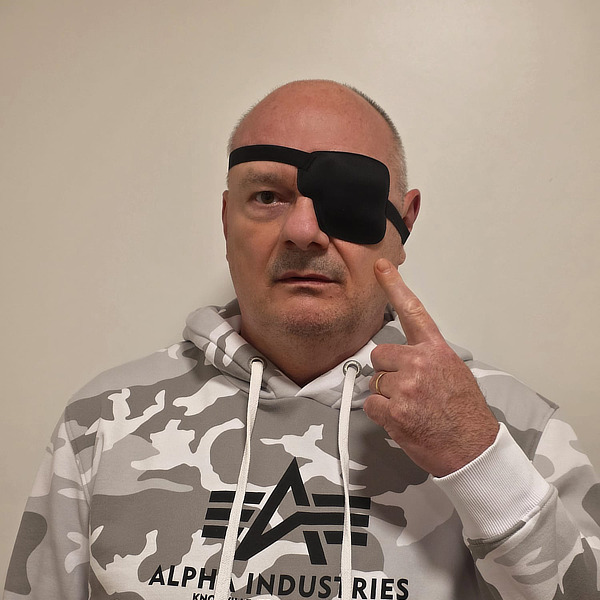
It is also important that the eye patch fits comfortably and reliably blocks out light. Many simple models (e.g., those sold in pharmacies) are less suitable, as they are usually too rigid and primarily intended as additional protection for a medical eye dressing. If the patch feels uncomfortable or irritating, the entire test becomes unpleasant—and because every face shape is different, it is sometimes difficult to find the perfect model right away.
However, there is one type of eye patch that has proven particularly effective in practice: adjustable eye patch. It is very comfortable for most people, seals completely lightproof, and can be customized if needed by adjusting or resewing the elastic bands. It is also available as a left or right version, allowing the affected eye to be covered optimally.
Alternatively, you may use a lightproof eye pad. In both cases, you will need to test whether it works better for you to keep the painful eye open or closed underneath. Many people also found it helpful to place a soft cosmetic tissue between the eye patch or eye pad and the eye to improve comfort.
If you wear glasses, you should—if possible—wear them over the eye patch or eye pad. If your vision becomes too blurry with the painful eye covered, simply cover the other eye instead. The effect remains the same as long as a binocular vision dysfunction is present.
If you have any questions, please send me an email at info@richtig-sehen.de
In this German-language video, you will find many additional details about the eye patch test for cluster headaches.
Important: No Improvement Does NOT Mean There Is No Binocular Vision Dysfunction
In about 30 percent of patients, the eye patch does not show any effect within the first three days. This does not rule out a binocular vision dysfunction. Pain medicine has long known that a tendon sheath inflammation can take several weeks to heal — even when the mechanical strain is removed immediately.
Applied to the trochlea, this explains why some patients only became pain-free after one or two weeks of wearing the eye patch. Of course, wearing the eye patch for such a long time is not feasible for everyone. Nevertheless, several patients with chronic cluster headaches report that they continued wearing it on their own for an extended period — and afterwards became completely pain-free for the first time.
Conclusion: If you do not experience noticeable improvement after two to three days, this is not an indication that no binocular misalignment is present.
Additional Note: Visible Misalignment of the Painful Eye
Even if the eye patch does not show an effect in the first few days, there is another strong indicator of a binocular vision dysfunction:
Many patients show a visible vertical deviation of the painful eye. The eye sits slightly higher or lower than the other. If this is the case — as shown in the example in the image below — this misalignment can be corrected with precisely fitted prism glasses. This removes the strain completely, allowing the tendon sheath inflammation to heal. Many people for whom the eye patch initially showed little effect became permanently pain-free after several weeks of wearing prism glasses.

Patient Experiences: Eye Patch Test for Cluster Headaches
Many patients experienced rapid or even complete improvement — others only after several days. Here are a few examples:
“From the day I put the eye patch on, I never had those cluster headaches again — and since receiving the prism glasses, they have never returned. I’ve been wearing the prism glasses for four months now. I can only thank Mr. Peschlow.” – Nini Mate
“After one week, the attacks were completely gone, and the eye patch reduced them from day one.” – Mandy Dahlke
“I was rather skeptical at first, but I didn’t want to leave it untried — especially because it sounded so ‘simple.’ I have episodic cluster headaches. In the middle of an episode, with the pain already at its worst, I came across the eye patch method and tried it immediately. I wore it consistently for 3 to 4 days. It felt as if the episode was coming to an end — the attacks became weaker over those 3 to 4 days. I then stopped wearing it for a few days, and the attacks intensified again, so I put it back on, and the attacks weakened once more. I kept wearing it until no attacks occurred and was then able to take it off — as if the eye patch had shortened the entire episode. The prism glasses have given me a completely new quality of life.” – Andi Dreas
“…especially since I had already been in a severe episode for three months — with up to seven attacks a day, taking 100 mg of cortisone and 1200 mg of verapamil daily, and none of it eased the pain. So I put the eye patch on in the morning, and my first thought was: ‘If this helps, I’ll eat a broom — including the cleaning lady. couldn’t believe it: the attacks immediately became less painful, and by the evening I was completely pain-free — even through the whole night, when the pain is usually at its worst. I then spent the next three days wearing the eye patch and could finally breathe again. But after taking it off, the full horror returned within three hours… and that’s when I had my proof that without a doubt, the problem was coming from the eye. I had always felt that the pain was connected to the eye, because during every attack I felt as if I wanted to tear the eye out.”– Alexandra Sandra Reek
“I wore the eye patch for about 24 hours, and then things improved significantly. After the second day, the attacks stopped, and only the pressure behind the eye remained. By the third or fourth day, even the pressure disappeared… I started this at a time when I was having about 5–8 attacks per day!” – Rogerio Da Silva
“Relief started after just one day. On the second day, the attacks were noticeably fewer. By around the fourth day, only the initial symptoms of an attack remained — but they disappeared on their own. I wore the eye patch for about 10 days, until I felt I no longer needed it. After that, I used it only ‘spontaneously,’ whenever an attack seemed to be starting. Two weeks later, the episode was over. After that, I received the prism glasses.” – Manuel Laukner
More experiences from my patients can be found here:
- Patient Experiences: Prism Glasses for Binocular Vision Dysfunction
- Patient Experiences: Prism Glasses for Cluster Headaches
How to Use an Eye Patch to Prevent Cluster Headache Attacks
If you do not yet have prism glasses, or prefer not to use them initially, an eye patch can be extremely helpful after a positive cover test. Many patients are able to prevent numerous attacks — provided the eye patch is used correctly and at the right moments. Whenever you find yourself in situations in which you typically experience an attack, you should cover the affected eye early. The eye patch prevents the eye movement muscles from having to compensate in these moments and removes the pain-triggering strain caused by binocular vision. Common situations include flickering light from candles or reflections, bright sunlight, heat, sauna, strong smells, loud noise, high altitudes, air travel, cinema, television, computer work, stress, or alcohol consumption. With alcohol in particular, it is essential to wear the eye patch for as long as the alcohol remains active in the body, because muscle strength decreases significantly during this time — and attacks are otherwise almost unavoidable.
A cluster headache patient from Austria shares in this German-language video a very compelling account of how significantly his quality of life improved with the help of an eye patch.